AMBASSADOR
a mobile application prototype that captures the fundamental concepts of the Information Systems major and communicates its purpose, goals, and benefits to Carnegie Mellon University student tour guides.
prototype
design
academic project
wireframing
prototyping
iterative design
interviewing
adobe xd
While Informations Systems (IS) at Carnegie Mellon University (CMU) is known to many and is ranked the best undergraduate IS program in the US according to U.S. News & World Report, there still exists a lot of misunderstanding about what IS is and what IS does because of its complex nature, leading to miscommunication.
Our project aims to create a design that captures the fundamental concepts of the IS program and communicates its purpose, goals, and benefits to a specific stakeholder group by making IS relevant to their needs and goals as gathered from user interviews.
Our project aims to create a design that captures the fundamental concepts of the IS program and communicates its purpose, goals, and benefits to a specific stakeholder group by making IS relevant to their needs and goals as gathered from user interviews.
Our stakeholder group was CMU student tour guides. We were able to interview those of diverse backgrounds, from various school years and majors to different genders and races.
Based on our interviews, we learned that our stakeholders, CMU student tour guides, applied to the job as they wanted to connect with and help people and overall be more involved in the CMU community. But at the same time, they also want to be able to keep on top of their schoolwork, which is relatively heavy, and ultimately maintain a healthy balance between it and their tour guide job.
It also became quickly apparent to us that many simply perceived IS as a combination of computer science and business, or more broadly, half technology and half humanities. Moreover, existing resources, such as the CMU IS website, have proven ineffective in aiding tour guides’ understanding of what IS is, as the information there is relatively generic and contains area-specific jargon that is confusing for non-majors.
This barrier, combined with tour guides’ busy schedules, has deterred them from exploring the subject further. And due to the fact that they do not know much about IS, as seen in the interview data, when they present the major to tours, it is kept very brief.
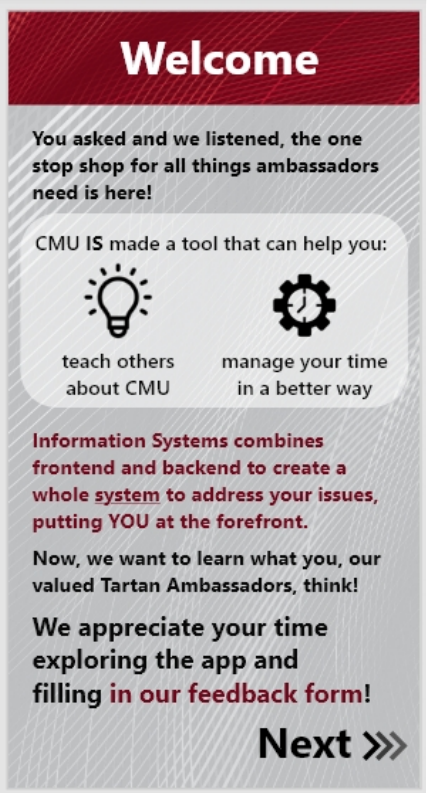
Understanding the concern of CMU student tour guides with balancing schoolwork and their job, we applied the principles of IS, such as database management and systems thinking, to create a mobile application that can help them keep track of their schedule. Additionally, we utilized the IS principle of applying current technologies to address user needs by incorporating an AI chatbot that answers any questions that they get on tour that they are not confident about how to answer to help them achieve their goal of helping others learn more about CMU. On top of all this, we added a page where users can give feedback. Information Systems is all about collecting, creating, and distributing useful data, so we will use their feedback to make the best version of the app possible. These three components make IS relevant to the tour guides because they demonstrate to them how the knowledge and skills IS majors acquire in their studies can help address real-world problems that they have. Users will be made aware that it is IS that brought to them this relevant product from the interactive elements strategically placed throughout the app revealing how different areas of IS played a part in the creation of each feature and the app as a whole.
Read the full report, which includes work in progress screenshots, here.
Based on our interviews, we learned that our stakeholders, CMU student tour guides, applied to the job as they wanted to connect with and help people and overall be more involved in the CMU community. But at the same time, they also want to be able to keep on top of their schoolwork, which is relatively heavy, and ultimately maintain a healthy balance between it and their tour guide job.
It also became quickly apparent to us that many simply perceived IS as a combination of computer science and business, or more broadly, half technology and half humanities. Moreover, existing resources, such as the CMU IS website, have proven ineffective in aiding tour guides’ understanding of what IS is, as the information there is relatively generic and contains area-specific jargon that is confusing for non-majors.
This barrier, combined with tour guides’ busy schedules, has deterred them from exploring the subject further. And due to the fact that they do not know much about IS, as seen in the interview data, when they present the major to tours, it is kept very brief.
Understanding the concern of CMU student tour guides with balancing schoolwork and their job, we applied the principles of IS, such as database management and systems thinking, to create a mobile application that can help them keep track of their schedule. Additionally, we utilized the IS principle of applying current technologies to address user needs by incorporating an AI chatbot that answers any questions that they get on tour that they are not confident about how to answer to help them achieve their goal of helping others learn more about CMU. On top of all this, we added a page where users can give feedback. Information Systems is all about collecting, creating, and distributing useful data, so we will use their feedback to make the best version of the app possible. These three components make IS relevant to the tour guides because they demonstrate to them how the knowledge and skills IS majors acquire in their studies can help address real-world problems that they have. Users will be made aware that it is IS that brought to them this relevant product from the interactive elements strategically placed throughout the app revealing how different areas of IS played a part in the creation of each feature and the app as a whole.
Read the full report, which includes work in progress screenshots, here.
After experiencing our mobile application, AMBASSADOR, tour guides will be able to understand some major subjects of study within IS such as database management systems, system design, and AI; how they back up technological functions like scheduling or chatbot; and the applications of these subjects in daily life.
On a higher level, we hope tour guides can tell the distinction between IS and CS after using our application, as we tried to show that IS incorporates users’ experience and task performance in application design and development instead of merely programming.
Note: Currently, there only exists a prototype for AMBASSADOR, but in the future, there may be consideration for full development of the mobile application.
On a higher level, we hope tour guides can tell the distinction between IS and CS after using our application, as we tried to show that IS incorporates users’ experience and task performance in application design and development instead of merely programming.
Note: Currently, there only exists a prototype for AMBASSADOR, but in the future, there may be consideration for full development of the mobile application.
undefined